
Tori Cone Development for Sheet Metal Fabrication
Tori cone development is an advanced flat pattern calculation used in pressure vessel fabrication, storage tanks, process equipment, and specialized sheet metal manufacturing. Unlike a standard cone, a Tori Cone incorporates one or more knuckle radii that create smooth transitions between the conical section and adjoining components.
These smooth transitions help reduce stress concentrations, improve structural performance, and satisfy engineering design requirements in many industrial applications.
In this guide, you’ll learn what a Tori Cone is, where it is used, the dimensions required for development, and how modern software can generate accurate flat patterns for fabrication.
What Is a Tori Cone?
A Tori Cone, sometimes referred to as a toriconical section, combines a conical surface with a knuckle radius to create a smoother geometric transition.
Unlike standard cones:
- Sharp intersections are replaced with radiused transitions.
- Stress concentrations are reduced.
- Fabricated components have improved structural characteristics.
- Designs often comply more easily with engineering standards.
Depending on the design requirements, a Tori Cone may include:
- Knuckle Radius at the Large End
- Knuckle Radius at Both Ends
These configurations are commonly used in pressure vessel and tank fabrication.
Where Are Tori Cones Used?
Tori cone developments are commonly used in:
- Pressure vessels
- Storage tanks
- Process equipment
- Chemical industry equipment
- Food processing vessels
- Pharmaceutical equipment
- Industrial reactors
- Custom-fabricated vessels
These applications often require smooth transitions between cylindrical and conical sections.
Types of Tori Cone Development
Tori Cone with Knuckle Radius at Large End
This configuration includes a knuckle radius connecting the cone to the larger diameter section.
Benefits include:
- Reduced stress concentration
- Improved structural integrity
- Smoother fabrication transitions
This design is frequently used in pressure vessel construction.
Tori Cone with Knuckle Radius at Both Ends
This configuration includes radiused transitions at both the large and small ends of the cone.
Benefits include:
- Improved load distribution
- Enhanced structural performance
- Better appearance and flow characteristics
These designs are often used in specialized process equipment and high-performance fabrication projects.
Dimensions Required for Tori Cone Development
Most Tori Cone calculations require:
- Large Diameter
- Small Diameter
- Cone Height
- Knuckle Radius
- Material Thickness (if compensation is required)
Additional dimensions may be required depending on the specific geometry.
Understanding Tori Cone Geometry
Tori Cone geometry is more complex than standard cone development because it combines:
- Conical surfaces
- Curved knuckle regions
- Multiple transition points
Accurate development requires proper calculation of:
- Cone geometry
- Radius transitions
- True lengths
- Developed pattern boundaries
Because of this complexity, manual development can be difficult and time-consuming.
For a general overview of cone geometry, see our Cone Development Guide.
For the fundamental formulas used in cone layout calculations, see our Cone Development Formula guide.
Manual Tori Cone Development Method
Traditional development methods typically involve:
- Defining cone dimensions.
- Defining knuckle radii.
- Establishing transition points.
- Calculating true lengths.
- Constructing the developed pattern.
- Verifying fabrication dimensions.
While these methods are effective, they require significant drafting effort and experience.
Example of Tori Cone Development
Consider a Tori Cone with:
- Large Diameter: 1000 mm
- Small Diameter: 500 mm
- Knuckle Radius: 100 mm
- Cone Angle: 32 degrees.
- Straight Face: 25 mm
Using these dimensions, an accurate flat pattern can be generated for fabrication.
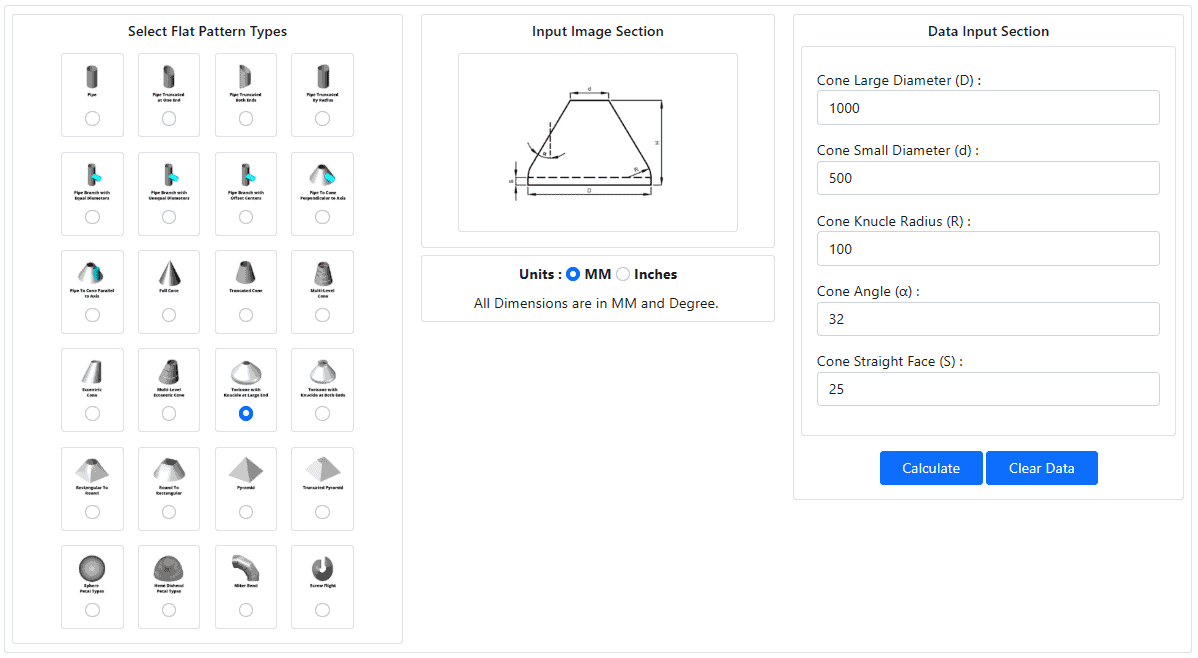
The typical workflow includes:
- Entering dimensions.
- Selecting the appropriate Tori Cone configuration.
- Generating the developed pattern.
- Reviewing calculated geometry.
- Exporting fabrication-ready outputs.

View our Cone Development Example to understand how flat patterns are generated from fabrication dimensions.
Need DXF export, professional PDF reports, fractional dimensions, and access to all flat pattern calculators? Explore Let’sFab Premium.
Common Challenges
Fabricators often encounter:
- Incorrect radius transitions
- Development boundary errors
- True-length calculation mistakes
- Complex geometry interpretation
- Time-consuming manual drafting
These issues can lead to fabrication errors and increased production costs.
Generate Tori Cone Flat Patterns Using Let’sFab
The Let’sFab Cone Development Calculator includes support for:
- Tori Cone with Knuckle Radius at Large End
- Tori Cone with Knuckle Radius at Both Ends
Simply enter the required dimensions and generate accurate flat patterns within seconds.
The calculator provides:
- Developed pattern layouts
- Fabrication dimensions
- PDF reports
- DXF export files (Premium)
- Manufacturing-ready geometry
This significantly reduces development time compared with traditional methods.
Try the free Cone Development Calculator
Explore Let’sFab Premium Software
Why Use a Tori Cone Development Calculator?
Using dedicated development software provides:
- Faster calculations
- Improved accuracy
- Reduced material waste
- Faster design revisions
- Consistent results
- Professional fabrication documentation
This is especially valuable for pressure vessel and process equipment fabrication.
Need DXF export, professional PDF reports, fractional dimensions, and access to all flat pattern calculators? Explore Let’sFab Premium.
Frequently Asked Questions
What is a Tori Cone?
A Tori Cone is a conical transition that incorporates one or more knuckle radii to create smoother geometric transitions.
Why are knuckle radii used?
Knuckle radii reduce stress concentrations and improve structural performance.
Where are Tori Cones commonly used?
Tori Cones are widely used in pressure vessels, tanks, process equipment, and industrial fabrication projects.
Is Tori Cone development more complex than standard cone development?
Yes. The addition of radius transitions increases geometric complexity and often requires specialized software.
Can Tori Cone developments be created manually?
Yes, but manual calculations can be time-consuming and require advanced drafting techniques.
Related Resources
- How to Calculate Cone Development
- Cone Development Formula
- Cone Development Example
- Full Cone Development
- Truncated Cone Development
- Eccentric Cone Development
- Cone Development Calculator
- LetsFab Premium FlatPattern Software
Conclusion
Tori Cone development is an advanced flat pattern calculation used in pressure vessels, storage tanks, and specialized fabrication projects. Because of the added complexity created by knuckle radii, accurate development calculations are essential for successful fabrication.
Modern development software can automate these calculations and generate fabrication-ready flat patterns within seconds, helping fabricators improve accuracy, reduce drafting time, and streamline production workflows.