
Multi-Level Concentric Cone Development for Sheet Metal Fabrication
Multi-level concentric cone development is a specialized flat pattern calculation used when multiple conical sections are combined along a common centerline. These stepped cone configurations are commonly found in industrial hoppers, process equipment, material handling systems, and custom fabrication projects.
Unlike a standard cone, a multi-level concentric cone consists of two or more connected conical sections, each with different dimensions. Accurate flat pattern development is essential to ensure proper assembly, minimize fabrication errors, and reduce material waste.
In this guide, you’ll learn what a multi-level concentric cone is, where it is used, the dimensions required for development, and how software can generate accurate fabrication layouts.
What Is a Multi-Level Concentric Cone?
A multi-level concentric cone is formed by combining multiple cone sections that share the same centerline.
Unlike a single cone:
- Multiple cone stages are used.
- Diameters change in steps.
- Each section has its own height and geometry.
- All sections remain concentrically aligned.
Because all cone stages share a common centerline, the geometry remains symmetrical and easier to fabricate than eccentric configurations.
These shapes are often referred to as:
- Stepped Cone
- Multi-Stage Cone
- Multi-Level Cone
- Concentric Stepped Cone
- Compound Cone
Although terminology varies, the development principles remain similar.
Where Are Multi-Level Concentric Cones Used?
Multi-level concentric cone developments are commonly used in:
- Hopper fabrication
- Material handling systems
- Storage vessels
- Process equipment
- Dust collection systems
- Cyclone separators
- Industrial transitions
- Custom fabrication projects
These applications often require multiple diameter reductions while maintaining a common centerline.
Dimensions Required for Multi-Level Concentric Cone Development
Typical calculations require:
- Large Diameter
- Small Diameter
- Section Heights
- No. of Levels
- Material Thickness (if compensation is required)
Each cone section contributes to the final developed pattern.
Understanding Multi-Level Cone Geometry
A multi-level concentric cone is essentially a series of connected cone developments.
The geometry requires:
- Individual cone section calculations
- Transition alignment
- True-length calculations
- Development continuity
Accurate calculations ensure all sections fit together correctly during fabrication.
For a general overview of cone geometry, see our Cone Development Guide.
For the fundamental formulas used in cone layout calculations, see our Cone Development Formula guide.
Manual Multi-Level Cone Development Method
Traditional development methods typically involve:
- Defining all cone stages.
- Calculating each cone section individually.
- Determining true lengths.
- Generating individual developments.
- Combining sections into a complete layout.
While effective, manual methods become increasingly complex as additional levels are added.
Example of Multi-Level Concentric Cone Development
Consider a stepped cone with:
- Large Diameter: 1000 mm
- Small Diameter: 400 mm
- Total Height: 800 mm
- No. of Levels: 2 Nos
Using these dimensions, the developed pattern can be generated for fabrication.
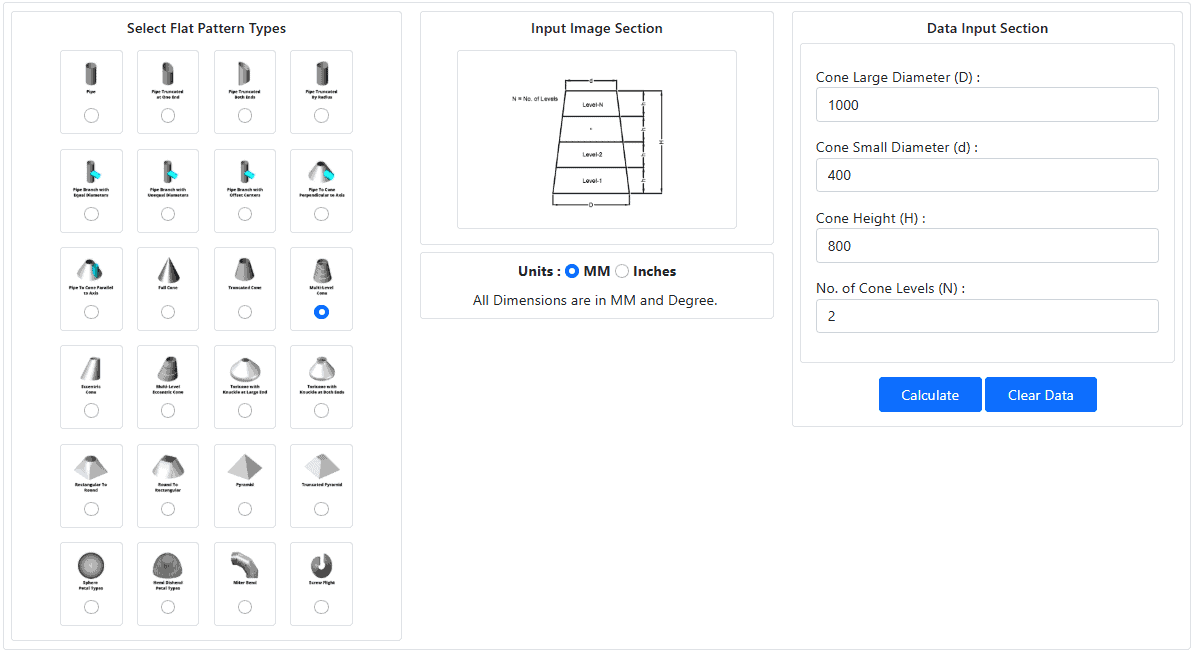
The workflow generally includes:
- Entering dimensions.
- Defining cone stages.
- Generating the development.
- Reviewing pattern geometry.
- Exporting fabrication-ready outputs.
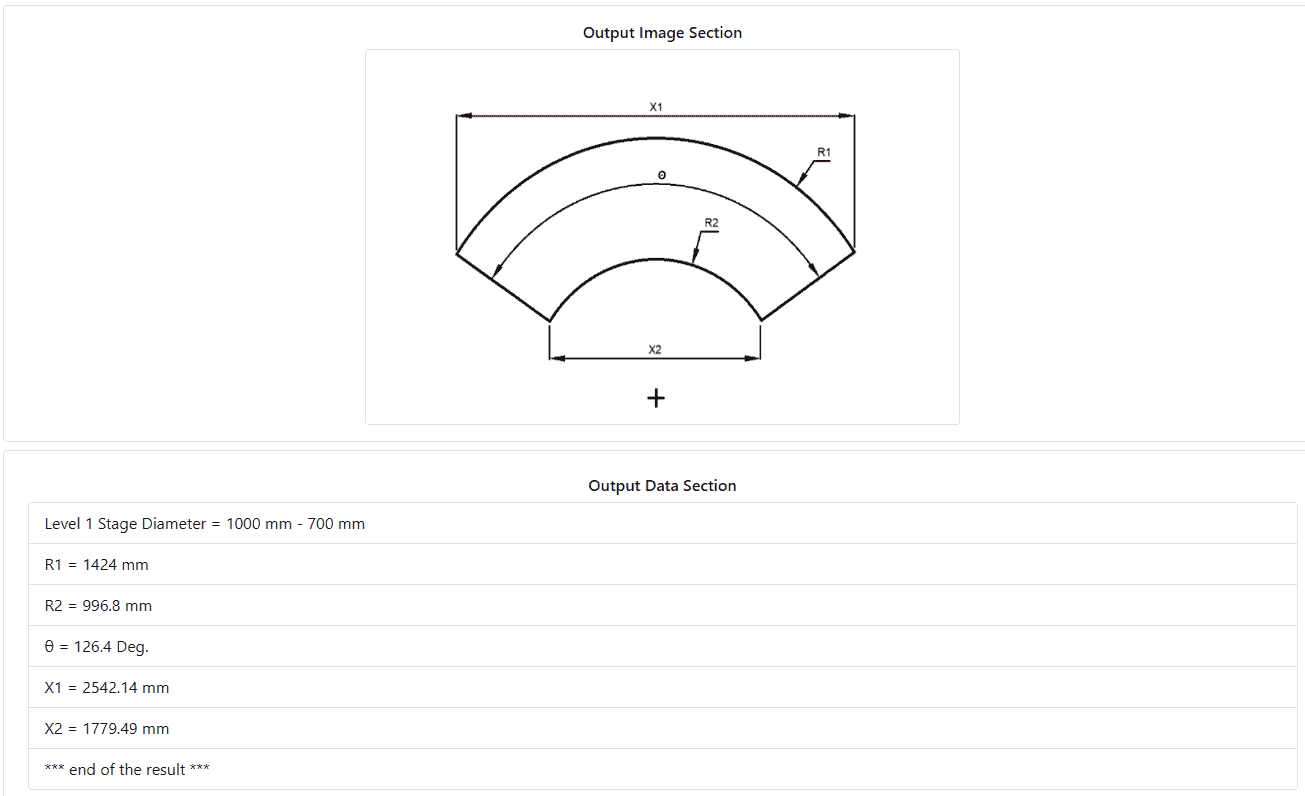
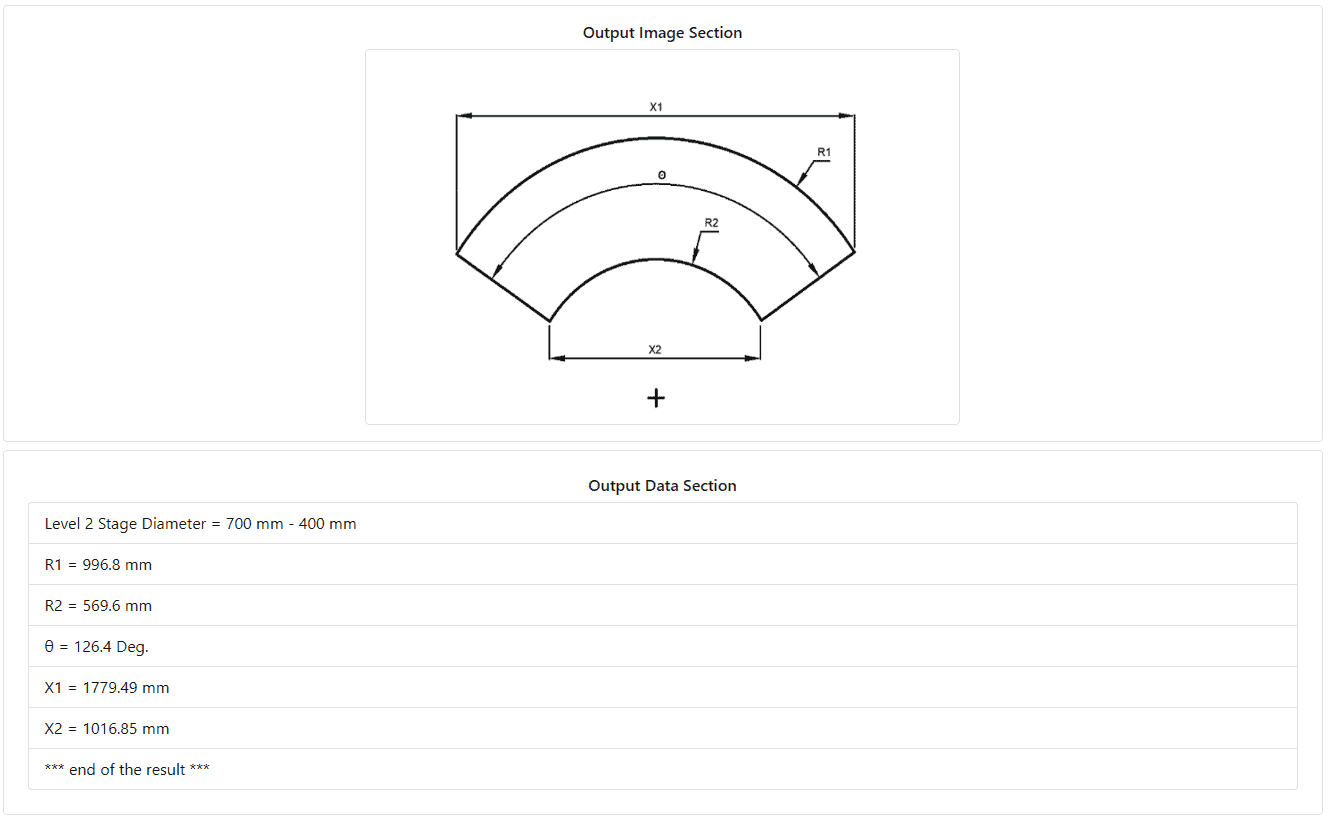
View our Cone Development Example to understand how flat patterns are generated from fabrication dimensions.
Need DXF export, professional PDF reports, fractional dimensions, and access to all flat pattern calculators? Explore Let’sFab Premium.
Common Challenges
Fabricators often encounter:
- Alignment errors between cone stages
- Incorrect true-length calculations
- Development continuity issues
- Repeated manual drafting work
- Pattern scaling mistakes
These problems can lead to fabrication delays and increased material consumption.
Generate Multi-Level Concentric Cone Flat Patterns Using Let’sFab
The Let’sFab Cone Development Calculator includes a dedicated Multi-Level Concentric Cone option for generating accurate flat patterns.
Simply enter the required dimensions and generate the complete development within seconds.
The calculator provides:
- Developed pattern layouts
- Manufacturing dimensions
- PDF reports
- DXF export files (Premium)
- Fabrication-ready geometry
This helps reduce drafting time and improve accuracy.
Try the free Cone Development Calculator
Explore Let’sFab Premium Software
Why Use a Multi-Level Cone Development Calculator?
Dedicated development software provides:
- Faster calculations
- Improved accuracy
- Reduced material waste
- Faster design revisions
- Consistent results
- Professional fabrication documentation
This is particularly valuable for custom fabrication projects involving multiple cone stages.
Need DXF export, professional PDF reports, fractional dimensions, and access to all flat pattern calculators? Explore Let’sFab Premium.
Frequently Asked Questions
What is a multi-level concentric cone?
A multi-level concentric cone consists of multiple connected cone sections that share a common centerline.
Where are stepped cones used?
Stepped cones are commonly used in hoppers, material handling systems, storage vessels, and industrial process equipment.
Why is multi-level cone development more complex?
Each cone section must be calculated individually while maintaining alignment and continuity throughout the development.
Can multi-level cones be developed manually?
Yes, but manual methods become increasingly complex as more stages are added.
What dimensions are typically required?
Most calculations require large diameter, intermediate diameters, small diameter, and section heights.
Related Resources
- How to Calculate Cone Development
- Cone Development Formula
- Cone Development Example
- Full Cone Development
- Truncated Cone Development
- Eccentric Cone Development
- Tori Cone Development
- Cone Development Calculator
- LetsFab Premium FlatPattern Software
Conclusion
Multi-level concentric cone development is a specialized flat pattern calculation used in advanced fabrication projects. Accurate layouts are essential for achieving proper fit-up, minimizing waste, and ensuring efficient fabrication.
Modern development software can automate these calculations and generate fabrication-ready patterns within seconds, helping fabricators improve productivity and accuracy.