
Full Cone Development for Sheet Metal Fabrication
Full cone development is one of the most fundamental flat pattern calculations used in sheet metal fabrication. A full cone consists of a circular base that tapers uniformly to a single apex point, creating a symmetrical conical shape.
Full cone developments are commonly used in hoppers, funnels, cyclones, material handling systems, and process equipment. Creating an accurate flat pattern is essential to ensure proper fit-up, minimize material waste, and simplify fabrication.
In this guide, you’ll learn what a full cone is, where it is used, the dimensions required for development, and how modern software can generate accurate flat patterns quickly and efficiently.
If you are new to the topic, first read our complete Cone Development Guide.
What Is a Full Cone?
A full cone is a conical shape that extends from a circular base to a single apex point.
Unlike a truncated cone, which has both a top and bottom diameter, a full cone contains:
- One circular base
- One apex point
- One sloping conical surface
Because of its simple geometry, the full cone is often the starting point for understanding cone development principles.
A full cone may also be referred to as:
- Concentric Cone
- Complete Cone
- Standard Cone
- Full Cone Layout
- Full Cone Flat Pattern
Where Are Full Cones Used?
Full cone developments are commonly used in:
- Hopper fabrication
- Funnels
- Cyclone separators
- Dust collection equipment
- Material discharge systems
- Storage vessel outlets
- Process equipment
- Industrial fabrication projects
These components often require custom dimensions, making accurate development calculations essential.
Dimensions Required for Full Cone Development
Most full cone calculations require:
- Base Diameter
- Cone Height
- Material Thickness (if compensation is required)
These dimensions are used to determine the slant height and developed pattern geometry.
Understanding Full Cone Geometry
A developed full cone typically forms a sector of a circle.
The geometry is defined by:
- Cone Diameter
- Cone Height
- Slant Height
- Sector Angle
- Developed Arc Length
These dimensions determine the final flat pattern used for fabrication.
For a deeper understanding of cone geometry, see our Cone Development Formula guide.
Full Cone Development Formula
The slant height is one of the most important dimensions in full cone development.
R = √(H² + (D/2)²)
Where:
- R = Slant Height
- H = Cone Height
- D = Cone Diameter
The slant height becomes the radius of the developed pattern.
The sector angle is then calculated to create the required cone geometry.
Manual Full Cone Development Method
Traditionally, fabricators create full cone layouts using geometric construction methods.
The process generally includes:
- Determining the cone dimensions.
- Calculating the slant height.
- Determining the sector angle.
- Drafting the developed pattern.
- Transferring the layout onto sheet material.
Although these methods remain useful, software tools can significantly reduce development time.
Example of Full Cone Development
Consider a full cone with:
- Diameter: 500 mm
- Height: 600 mm
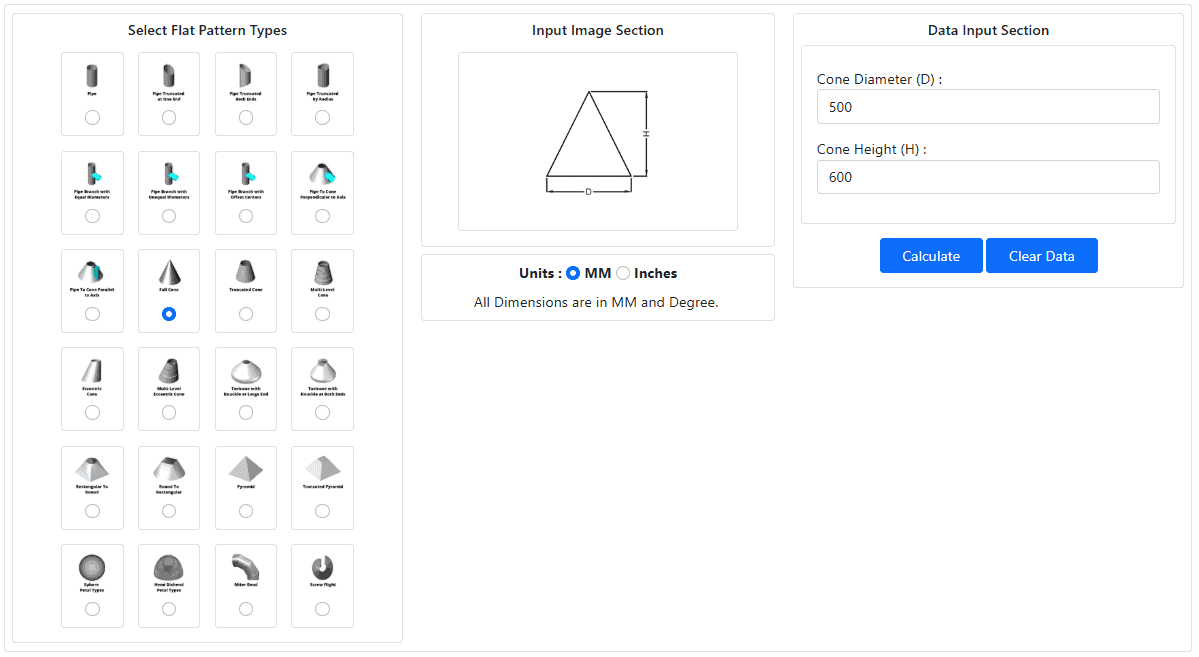
Using these dimensions:
- Slant Height ≈ 650 mm
- Sector Angle ≈ 138.46°
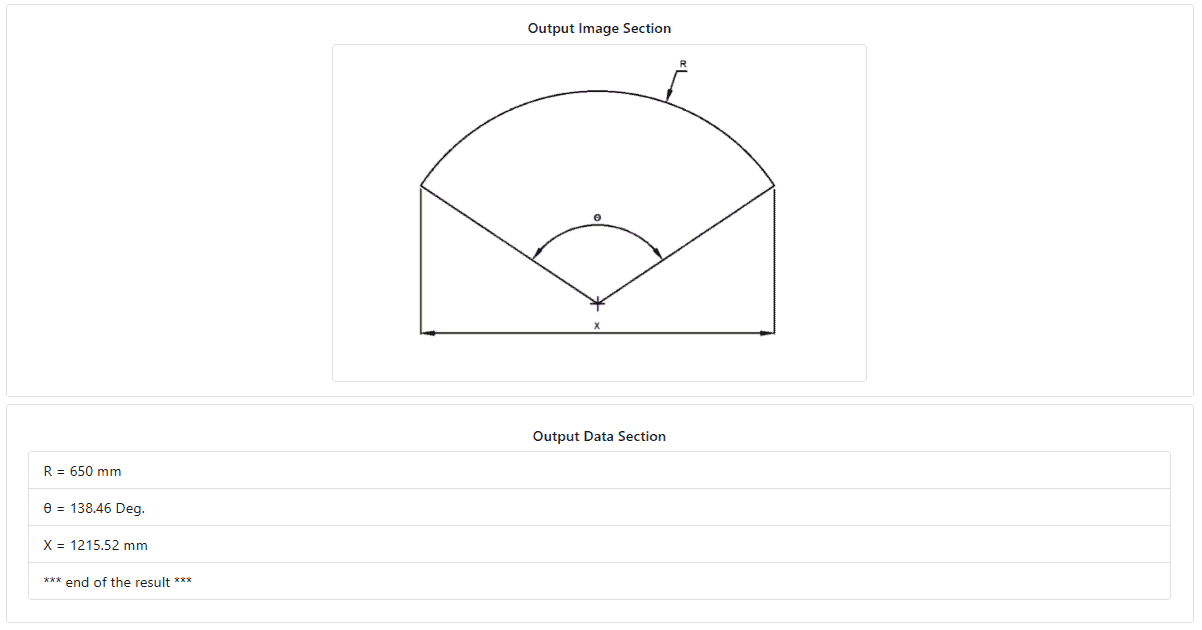
The resulting flat pattern can then be cut and rolled to create the final cone.
For a complete worked example, see our Cone Development Example article.
Common Challenges
When creating full cone developments manually, fabricators often encounter:
- Calculation errors
- Incorrect slant heights
- Pattern scaling issues
- Drafting inaccuracies
- Repetitive calculations for multiple sizes
These issues can lead to fabrication delays and material waste.
Generate Full Cone Flat Patterns Using Let’sFab
The Let’sFab Cone Development Calculator includes a dedicated Full Cone option that generates accurate flat patterns in seconds.
Simply enter:
- Cone Diameter
- Cone Height
The calculator automatically generates:
- Developed pattern layout
- Fabrication dimensions
- PDF reports
- DXF export files (Premium)
- Manufacturing-ready geometry
This allows fabricators to create accurate layouts much faster than manual methods.
Why Use a Full Cone Development Calculator?
Using a dedicated development calculator offers several benefits:
- Faster calculations
- Improved accuracy
- Reduced material waste
- Consistent results
- Faster design revisions
- Professional fabrication documentation
For fabrication shops and engineering teams, this can significantly improve productivity.
Need DXF export, professional PDF reports, fractional dimensions, and access to all fabrication calculators? Explore Let’sFab Premium.
Frequently Asked Questions
What is a full cone?
A full cone is a conical shape that tapers from a circular base to a single apex point.
What is the difference between a full cone and a truncated cone?
A full cone has an apex point, while a truncated cone has the top section removed and contains two circular openings.
What dimensions are required for full cone development?
Most full cone developments require the base diameter and cone height.
Can full cone development be calculated manually?
Yes. Traditional geometric construction methods can be used, although software tools provide faster and more accurate results.
Where are full cones commonly used?
Full cones are widely used in hoppers, funnels, cyclones, discharge systems, and industrial process equipment.
Related Resources
- How to Calculate Cone Development
- Cone Development Formula
- Cone Development Example
- Truncated Cone Development
- Eccentric Cone Development
- Tori Cone Development
- Multilevel Concentric Cone Development
- Multilevel Eccentric Cone Development
- Cone Development Calculator
- LetsFab Premium FlatPattern Software
Conclusion
Full cone development is one of the most widely used flat pattern calculations in sheet metal fabrication. Accurate layouts are essential for producing high-quality conical components while minimizing material waste and fabrication time.
Although traditional geometric methods remain valuable for understanding cone geometry, modern development software can automate calculations and generate fabrication-ready flat patterns within seconds.