
Cone Development Example for Sheet Metal Fabrication
Understanding cone development becomes much easier when working through a practical example. If you are new to the topic, first read our complete Cone Development Guide.. In this article, we’ll look at a typical cone development scenario used in sheet metal fabrication and show how a flat pattern can be generated for manufacturing.
Whether you’re fabricating a hopper, funnel, reducer, or duct component, the same development principles apply.
Project Requirements
Assume we need to fabricate a conical component with the following dimensions:
- Base Diameter: 600 mm
- Cone Height: 500 mm
- Material: Mild Steel Sheet
The goal is to generate the flat pattern required for cutting and rolling the sheet into the final cone shape.
Understanding the Geometry
A cone is created by rolling a sector of a circle into a three-dimensional shape.
To create an accurate flat pattern, the following must be determined:
- Cone diameter
- Cone height
- Slant length
- Developed arc length
These dimensions define the shape and size of the developed pattern.
To understand the theory behind these calculations, see our detailed guide on Cone Development Formulas.
Traditional Development Process
Using manual methods, a fabricator would typically:
- Draw the cone geometry.
- Calculate the slant length.
- Determine the developed arc length.
- Construct the pattern layout.
- Transfer the pattern onto sheet material.
Although effective, this process can be time-consuming when multiple cone sizes are required.
Using a Cone Development Calculator
Modern fabrication software can generate the pattern instantly.
By entering the required dimensions into the Cone Development Calculator, the complete flat pattern can be produced within seconds.
Try the free Cone Development Calculator to generate flat patterns for full cones, truncated cones, eccentric cones, and other cone geometries.
Example Input
- Cone Type: Full Cone
- Base Diameter: 600 mm
- Height: 500 mm
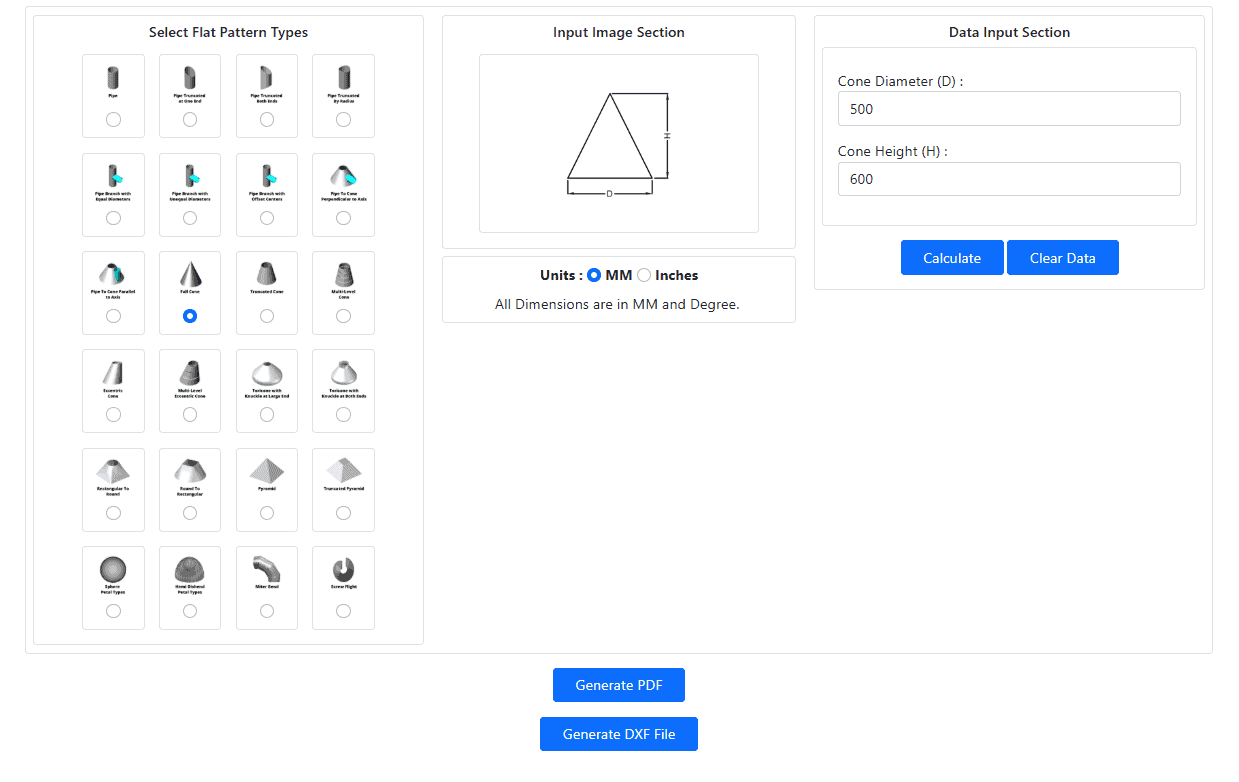
Input Values
| Parameter | Value |
|---|---|
| Cone Diameter | 500 mm |
| Cone Height | 600 mm |
Example Result
The calculator generates:
- Developed cone layout
- Pattern dimensions
- Fabrication-ready geometry
- Export options for documentation and manufacturing
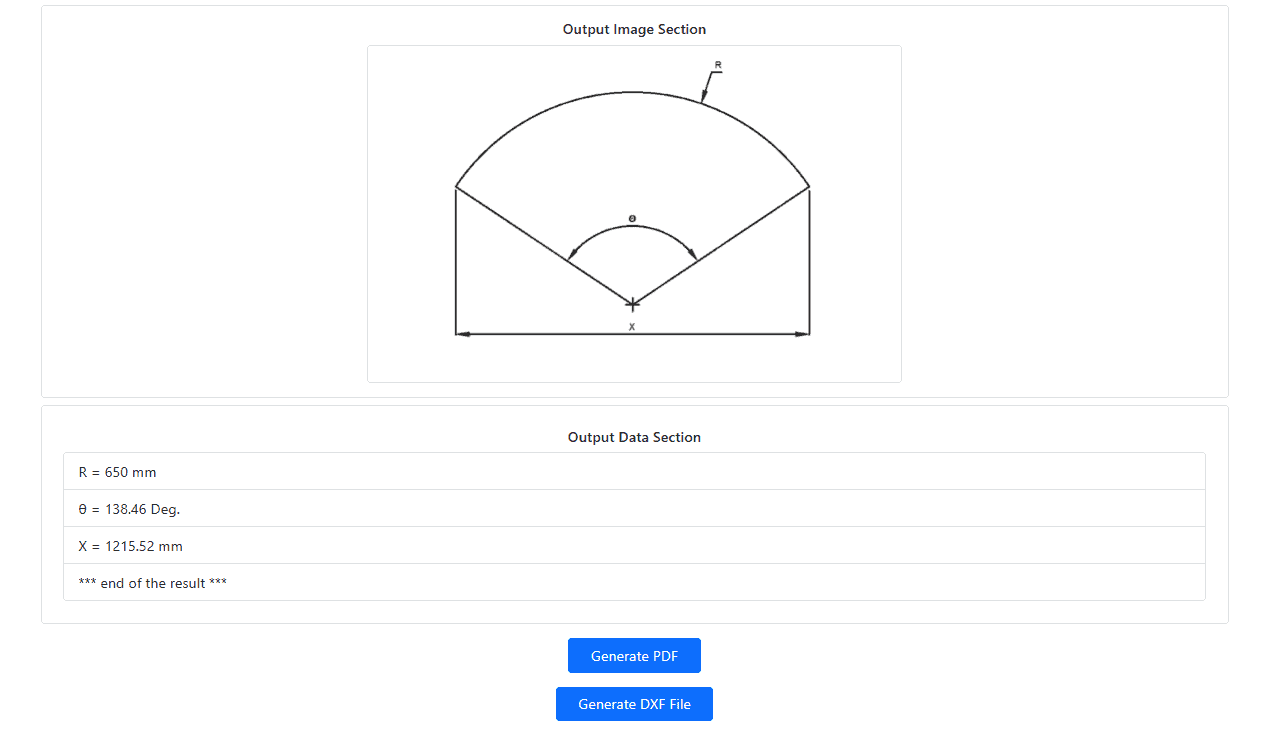
Calculated Results Data
| Result | Value |
|---|---|
| Radius (R) | 650 mm |
| Sector Angle (θ) | 138.46° |
| Pattern Width (X) | 1215.52 mm |
Need DXF and PDF Export?
The free calculator is ideal for quick calculations. If you need fabrication-ready DXF files, professional PDF reports, fractional dimensions, and access to all flat pattern calculators, explore Let’sFab Premium.
Why Accurate Cone Development Matters
Accurate flat pattern generation helps:
- Reduce material waste
- Improve fit-up accuracy
- Minimize fabrication errors
- Reduce workshop rework
- Improve production efficiency
Even small dimensional errors can become significant during rolling and assembly.
Common Applications
This type of cone development is commonly used for:
- Hoppers
- Funnels
- Cyclone separators
- Dust collection systems
- Duct reducers
- Material handling equipment
Because these components are often custom-sized, accurate pattern generation is essential.
Generate Cone Flat Patterns Faster
Instead of manually creating cone layouts, fabricators can use the Let’sFab Cone Development Calculator to generate patterns instantly.
The calculator supports multiple cone configurations including:
- Full Cones
- Truncated Cones
- Eccentric Cones
- Multi-Level Cones
- Tori Cones
Users can quickly generate fabrication-ready layouts and streamline their design workflow.
Related Resources
- How to Calculate Cone Development
- Cone Development Formula
- Full Cone Development
- Truncated Cone Development
- Eccentric Cone Development
- Tori Cone Development
- Multilevel Concentric Cone Development
- Multilevel Eccentric Cone Development
- Cone Development Calculator
- LetsFab Premium FlatPattern Software
Ready to generate your own fabrication layout? Use the free Cone Development Calculator to create accurate flat patterns in seconds. Need DXF export, PDF reports, and access to all fabrication calculators? Upgrade to Let’sFab Premium.
Conclusion
This example demonstrates the basic workflow used to create a cone development for sheet metal fabrication. While traditional geometric construction methods remain useful, modern development software can dramatically reduce calculation time and improve accuracy.
For projects involving multiple cone sizes or complex geometries, using a dedicated cone development calculator is often the fastest and most reliable solution.